http://sports.espn.go.com/nfl/columns/story?columnist=chadiha_jeffri&id=3498223
The idea of this list is to take the top 10 players who are the most irreplaceable on their teams. The answer for number 1 is simple: Peyton Manning. Now, Tom Brady may go down as one of the best, if not the best, quarterback in history, and this is coming from a teal-and-orange-bleeding Dan Marino fan. The list isn't about the best player though, it's the most indispensable.
If Tom Brady goes down, the Pats still have their defense, they still have their absurd offensive line, and they still have Randy Moss. The same Randy Moss that made Daunte Culpepper look like a good quarterback. They're obviously not as good without Brady, but they're still a lock for the playoffs in the weak AFC East.
Peyton Manning isn't just the quarterback of the Colts, he's pretty much the offensive coordinator as well. Peyton Manning runs the offense like he's playing Madden. The play that he came to the line with is merely a suggestion. He takes a look at what the defense is throwing at him, turns his head, waves his arms around, and chooses a play to beat that defensive scheme. If Peyton goes down, Tony Dungy won't, nor should he, allow Jim Sorgi to run the offense. The Colts would go from one of the most dynamic offensive teams to another team that has the play called in from the sideline.
T.O. is a joke at number 3. He was tied for 20th in the league for receiving yards per game last season. The Cowboys are still very good without T.O.
Looking down the list, with a Defensive Tackle in 6th, I can only imagine that this article is meant as some sort of comment or blog bait meant to annoy people and argue about why he's wrong. Well, I bit.
Tuesday, July 22, 2008

Ed Price: Wrong; Craig Breslow: awesome
I was reading through Emma Span's excellent blog, Eephus Pitch, when I came across this link. Ed Price of the Newark Star-Ledger notes that Twins pitcher Craig Breslow threw two wild pitches and also balked. Price cites the baseball-reference.com Play Index and declares that this is the first time any reliever has accomplished such a dubious feat.
Well, you know that I have an affinity for both the B-R.com play index and dubious random feats, so I decided to see what other balk-walk combos there have been. I started with Price's search, and here are the results. As you can see, Breslow is far from being the first ever reliever to have two wild pitches and a balk in a single game. It has been a while since someone has done it, but it's happened sixteen times since 1956. Some pitchers have even had two balks to go with their two wild pitches.
So I don't know what kind of search Mr. Price did, but Breslow is not remarkable for what he did last night. He is, however, a remarkable person. A journeyman left-handed pitcher, Breslow graduated from Yale in 2002 with degrees in both molecular biophysics and biochemistry. After his first season in pro-ball, he interned at a Yale lab studying stem-cell research. Since then he has started a cancer-reasearch charity, the Strike3Foundation, with his sister, a thyroid cancer survivor. Kudos to anyone else who combines my dual love for biology and baseball!
As for Ed Price, well....

Update: Ed Price has altered his post and apologizes for the misleading info. Hooray!
Well, you know that I have an affinity for both the B-R.com play index and dubious random feats, so I decided to see what other balk-walk combos there have been. I started with Price's search, and here are the results. As you can see, Breslow is far from being the first ever reliever to have two wild pitches and a balk in a single game. It has been a while since someone has done it, but it's happened sixteen times since 1956. Some pitchers have even had two balks to go with their two wild pitches.
So I don't know what kind of search Mr. Price did, but Breslow is not remarkable for what he did last night. He is, however, a remarkable person. A journeyman left-handed pitcher, Breslow graduated from Yale in 2002 with degrees in both molecular biophysics and biochemistry. After his first season in pro-ball, he interned at a Yale lab studying stem-cell research. Since then he has started a cancer-reasearch charity, the Strike3Foundation, with his sister, a thyroid cancer survivor. Kudos to anyone else who combines my dual love for biology and baseball!
As for Ed Price, well....
Update: Ed Price has altered his post and apologizes for the misleading info. Hooray!
Thursday, July 17, 2008
Left-Handed Third Basemen
 In the year-and-a-half since I've started the blog, there have been 109 posts. According to my Stat Counter statistics, the most popular post of all is this one, on the history of left-handed second basemen in the major leagues. Well, I've never been one above pandering to my audience, and plenty of people have come here in search of answers regarding other southpaw infielders. So let us take a look at the history of the even rarer Left-Handed Third Baseman.
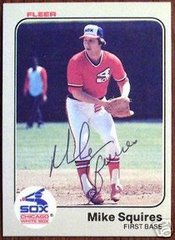
The play-index over at Baseball-reference.com allows one to search on a variety of parameters, and here is the result of searching for all hot-corner lefties since 1956 (the first year of full regular-season box score data). Indeed, there are just four players to have donned gloves on their right hands and played third base in the last fifty-four years. The earliest of these is Mike Squires, whose official position was third base in 13 games spread over two seasons.
The first game was on August 23, 1983. Squires had played over five seasons in the majors at this point, primarily at first base, even earning a gold glove in 1981. But on this day Squire's White Sox were getting blown out by the Royals, and manager Tony LaRussa decided to clear his bench. Between the sixth and eighth innings, LaRussa replaced all but two fielders. Quizzically, he did not replace first baseman Greg Walker with Squires, instead having the latter replace Vance Law at third base. In doing so, Squires was noted at the time for becoming the first left-handed third baseman in over 50 years, which reaches back beyond the baseball-reference.com data.
That Time Magazine article notes that Washington Senators first baseman Joe Kuhel attempted one game at third base in 1936. BR.com does record Kuhel's fielding at first base but not third; however, retrosheet.org records Kubel as having two assists in a game in 1936. The box-score of this game has, presumably, been lost to the sands of time.
Mike Squires, meanwhile, did not record a putout or assist in his first action at third base; that would have to wait until 1984. On April 8, LaRussa pinch hit Squires for Law in the bottom of the seventh and then sent him to third for the eighth. Squires was immediately tested as Tigers' hitter Lance Parrish grounded one to third. Squires fielded and threw cleanly for the first assist by a left-handed third baseman in 48 years. In total Squires made 3 putouts and had 9 assists from third base in his 38 innings there, earning a perfect 1.000 fielding percentage. Notably, Squires played two innings at catcher in the major leagues, another position with very few southpaws.
Squires also managed to have an interesting three-position gambit in one game: first-base, third-base, pitcher. Yes, on April 22, 1984, Squires was asked to finish a game against the Detroit Tigers. He had started the game at first base; moved to third in the eighth, and then with two outs in the eighth LaRussa called on Squires with runners on first and second. Squires threw one pitch to Tom Brookens and induced a fly ball to centerfield to end the inning and Squires' pitching career. Surprisingly, this position combination has been tried four times since 1956; and two of them are by a friend from the last paragaph-- Vance Law.
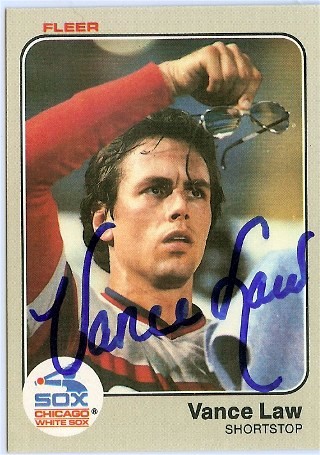
The world would not have to wait another half-century for the next lefty third-baseman. Just over a year after Squires' final game at third base, Montreal Expos manager Buck Rodgers followed LaRussa's lead and inserted left-handed Terry Francona at third base. It was October 6, 1985, the last game in a third-place season for the Expos, and the starter at third base was-- Razor Shines. The 28-year old had a name much better than his ability (hit .185/.239/.198 in 81 career at bats). Wikipedia notes that he spent sixteen years in the minors, and is currently a manager for the Clearwater Threshers of the FSL. Anyway, Rogers must have seen enough (or there was an injury) and replaced Razor Shines with utility player (and current Red Sox manager) Terry Francona. It was the only appearance at third base in Francona's career, and he made good on all three of his assist chances. Francona was then replaced himself in the bottom of the eighth by.... Vance Law. Cue creepy music.
It would be a not quite a year after Francona's game at third, when the New York Yankees suffered an injury to regular third baseman Mike Pagliarulo on August 25. The Yankees then left for a west-coast trip, and in a game on August 29, suffered another injury, this time to shortstop Mike Fischlin. Mattingly himself vaguely recalled the circumstances in a November 2004 interview on his website. From the boxscore, it seems as though the players were shuffled around the field, with Mattingly moving from first to third. Mattingly started an around-the-horn double play to end his first inning of work at the hot corner. He would have five other assists and a putout in the rest of the game. The next day, Mattingly actually started the first game in a doubleheader at third base, though he moved to first in the sixth inning. Wayne Tolleson replaced him at third and started the second game. Pags did pinch hit in both games but did not return to regular action until September 4. Mattingly played one more game at third and that was it for his career.
Another decade passed before the next, and latest lefty third baseman. Mariners' utility man Mario Valdez pinch hit in the 8th and then played his only inning of third base in the ninth inning, but did not have a ball hit to him. And that's all for left-handed third basemen. The prospect of having to turn your back to the plate to throw across the diamond must not be appealing to most managers. One would think it would be an advantage on reaction plays down the line, while a disadvantage over a ball between third and short. Fielding bunts down the third base line would also be quite difficult for a lefty, I suppose.
Next time, we'll check out the even shorter list of left-handed shortstops. I find these investigations extremely interesting, because I get to pick out some of the rarer things in baseball history, and they always seem to coincide with other wacky events!
Tale of the Tape
Source: ESPN
Unless, of course, this unsubstantiated rumor were true. Which it isn't.
Dear Brian Cashman:
Wednesday, July 16, 2008
The Anti-Cookie
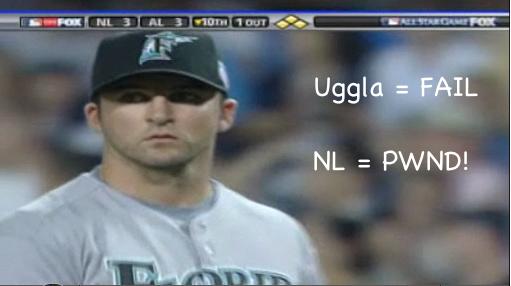
If there were such a thing as an anti-cookie, Dan Uggla has earned it. With a chance to highlight the Marlins' surprising season on national TV, Uggla entered the All-Star game in the bottom of the sixth as a defensive replacement. His night:
Bottom sixth: Caught pop-up off bat of Joe Crede for the second out.
Top eighth: Struck out swinging with go-ahead runner on first.
Top tenth: With two on and one out, grounded into a 4-6-3 double play
Bottom tenth: Botches an easy grounder to allow Michael Young to reach leading off
Bottom tenth: Next batter, Carlos Quentin, also hits one to Uggla, and it bounces off his chest for another error.
Bottom tenth: The very next batter hits another one to Uggla, and with the bases loaded Uggla takes his sweet time throwing home, allowing Sizemore to reach base, re-loading the bases.
Top twelfth: Uggla strikes out looking on three pitches, including getting frozen on a 67-mph curveball from Joakim Soria.
Bottom twelfth: Uggla manages to not screw up, getting Grady Sizemore on a ground out despite not catching the ball cleanly.
Bottom thirteenth: J.D. Drew reaches on Uggla's third fielding error, which sets an All-Star game record.
Top fifteenth: Uggla manages to get to four pitches this time but strikes out on a 93-mph fastball from Scott Kazmir.
So, Uggla had five ground balls hit to him, and he fielded none of them cleanly. He batted four times and failed miserably each time. Sure, none of the errors actually resulted in runs for the AL and the NL managed to score runs in two of the innings where Uggla batted. Still, for such an epic breakdown on a national stage, we shall reward him with the first ever Food Lion Anti-Cookie (Definitely Not Sponsored by Food Lion). If I could follow him around all day giving him the sarcastic slow-clap, I would.
Also, to the National League: thanks for playing. Your inferiority is unparalleled.
Monday, July 7, 2008
Shannon Rowbury-- Olympian
If there is one area of society through which most Americans live vicariously, it is the world of sport. Those of us blessed with only enough athletic talent which is useful for such feats as company softball and backyard beer pong have to gain their glory by raising athletes to hero status. Their success is ours; their rivals' defeats our schadenfraude. For me, I find this kind of self-worth especially gratifying when looking at people my own age, the success of others somehow justifying my mediocre existence; at least someone has done something with the same 24 years I've gotten.
So it was with great pride that I watched the women's 1500 m race at the US Olympic Trials in Eugene, Oregon last night. The favorite going into the race was fellow Duke graduate Shannon Rowbury, who previously had turned in the fastest US time in five years at an earlier meet. Rowbury was in my freshman dorm at Duke, and so somehow I feel that the vicariousness is closer. Also in the race was former UNC student Erin Donahue, who I met while attending a track camp back in high school. As they announced the contestants, there was another interesting side-story, a 16-year old girl, Jordan Hasay, had qualified for the final, shattering the high school record to do so.
Soon after the gun sounded, a slow pace was set by some of the underdogs in the race. This seemed to be counter-intuitive; in order to go to Bejing, a runner not only had to finish in the top 3 but also make the Olympic qualifying time of 4:07.00. Only five runners in the race (including Rowbury and Donahue) had such a mark, so it would have made sense for those who had not eclipsed that time to do so in this race. After running the first 1100 meters in about 2:50, Rowbury tired of staying with the pack and broke free. Her lead over the second group widened with 200 meters to go and Rowbury crossed the finish line with a solid 4:05.48. Said Rowbury after the race:
Rowbury joins several former ACC track stars on the US team. Donahue qualified by finished second in the race, and Walter Dix of FSU filled the gap voided by injured superstar Tyson Gay by winning the 200 m final in 19.86 seconds. Fellow Duke grad Jillian Schwartz failed to qualify in a hotly contested pole vault field; a headwind complicated matters and even Sydney gold medalist Stacy Dragila failed to qualify.
Shannon Rowbury joins an illustrious cast of successful characters from my freshman dorm. There's Doug Kim, who finished at the final table in the 2006 World Series of Poker; Dan "DJ Sensei" Morris has also made a name for himself in the world of online poker. Yet another poker player, Dave Mosca, has his own start-up company. Someday, when this blog is the number one blog about a quirky baseball feat, I can join their lofty status. Someday.
So it was with great pride that I watched the women's 1500 m race at the US Olympic Trials in Eugene, Oregon last night. The favorite going into the race was fellow Duke graduate Shannon Rowbury, who previously had turned in the fastest US time in five years at an earlier meet. Rowbury was in my freshman dorm at Duke, and so somehow I feel that the vicariousness is closer. Also in the race was former UNC student Erin Donahue, who I met while attending a track camp back in high school. As they announced the contestants, there was another interesting side-story, a 16-year old girl, Jordan Hasay, had qualified for the final, shattering the high school record to do so.
Soon after the gun sounded, a slow pace was set by some of the underdogs in the race. This seemed to be counter-intuitive; in order to go to Bejing, a runner not only had to finish in the top 3 but also make the Olympic qualifying time of 4:07.00. Only five runners in the race (including Rowbury and Donahue) had such a mark, so it would have made sense for those who had not eclipsed that time to do so in this race. After running the first 1100 meters in about 2:50, Rowbury tired of staying with the pack and broke free. Her lead over the second group widened with 200 meters to go and Rowbury crossed the finish line with a solid 4:05.48. Said Rowbury after the race:
"I reacted well and was able to bring home the win. I'm so excited because we have a great contingent going to Beijing. Should be an exciting next couple of months and I can't wait till August."
Rowbury joins several former ACC track stars on the US team. Donahue qualified by finished second in the race, and Walter Dix of FSU filled the gap voided by injured superstar Tyson Gay by winning the 200 m final in 19.86 seconds. Fellow Duke grad Jillian Schwartz failed to qualify in a hotly contested pole vault field; a headwind complicated matters and even Sydney gold medalist Stacy Dragila failed to qualify.
Shannon Rowbury joins an illustrious cast of successful characters from my freshman dorm. There's Doug Kim, who finished at the final table in the 2006 World Series of Poker; Dan "DJ Sensei" Morris has also made a name for himself in the world of online poker. Yet another poker player, Dave Mosca, has his own start-up company. Someday, when this blog is the number one blog about a quirky baseball feat, I can join their lofty status. Someday.
Friday, July 4, 2008
Checking in on Da Bulls
It was more than a year ago when we awarded our very first Publix Cookie Lifetime Achievement Award to Chris Mason, then pitching for the Montgomery Biscuits. He threw an Immaculate Inning, and while this sort of thing may be more common than we realize in the minor leagues, it was the first we had heard about. The pitching coach that day actually said he was disappointed in Mason for not "working the count," but of course pitching an Immaculate Inning is way more impressive than throwing waste pitches so far out of the zone that it makes the hitter giggle. Mason finished last season very well, throwing 161.1 innings with 136 strikeouts, 44 walks, and a sparkling 2.57 ERA. The Gastonia, NC got to come home this season as he was assigned to the Durham Bulls.
Last night, I went to see the Bulls take on the Charlotte Knights, and Chris Mason was the starter. Mason has struggled this season, and holds a 6.38 ERA in 17 starts, though he's still striking out a lot of hitters- 77 in 86 innings, with a respectable number of walks (29). He's just giving up way too many home runs, 18 so far! He's currently the worst starter on a staff that is in the middle of the pack in the International League (4.51 runs/game). It's the excellent hitting that has propelled the Bulls to first place in their division. On July 3 they were taking on a Charlotte Knights team that was 10 games under .500, but this game was all Knights from the beginning.
In the first inning, Mason came out throwing his 92 mph fastball up in the zone, and paid for it. He gave up a leadoff double to Jason Bourgeois, a 26-year old minor league lifer. After inducing a groundout to first, up came David Cook, another 26-year old only recently promoted from AA. Cook jumped all over a 2-1 slider and hit a bullet to the centerfield lawn for a two-run homer. Mason later gave up a double in the inning, but stranded that runner. The second inning didn't start off well, allowing a bloop single to yet another 26-year old, Fernando Cortez. Backup catcher Hector Gimenez tried to pick off Cortez with a snap throw that ended up going down the right field line. Mason walked the next batter and then Knights manager Gary Allenson went small ball, calling for a sac bunt followed by a Sac Fly from Bourgeois.
Mason then calmed down for two innings, and had a nice play on a comebacker in the fourth inning, making a diving stop to his left. He would give up another run in the fifth on a double by Bourgeois and an RBI single by Danny Richar, but got a 6-4-3 double play to end the first half of the game with the Bulls trailing 4-0. Mason's night was done and the numbers weren't pretty: 5 IP 6 H 4 R (all earned) 1 BB 3 K, and just 49 of his 76 pitches were strikes. The Bulls would rally in the bottom of the fifth, including an impressive play by first baseman Chris Richard, who scored from second on an infield single. Fernando Perez would add a two-run double to make the score 4-3, but the Knights pulled away in the 7th inning due to innefective relief work from Kurt Birkins and Nick Debarr (whose first pitch was wild, allowing the fifth run to score from third).
The loss drops Mason's record to 3-9 on the season, but he gave up another home run, which is probably more damaging to his prospect chances. Mason recently turned 24, and with Tampa Bay's pitching staff beginning to come together, Mason needs to regain the control he had as a Montgomery Biscuit last year. As for the Bulls, their strengths continue to be hitting, though they are weaker on the prospect front than previous years. The top youngsters on the team are infielders: there's Reid Brignac, a 22 year old shortstop who didn't play last night. Eliot Johnson played short last night but normally plays second base; the 23 year old is infamous already for colliding with Yankees' catching prospect Fransisco Cervelli in a spring training game, breaking the catcher's wrist. Finally there's 23-year old 3B/OF Joel Guzman, who is playing in his third season with the Bulls. Guzman is famous locally for a tape-measure home run in 2007 that reached, in dead centerfield, the third floor of the then under-construction Diamond View office building. Guzman has the most cups of coffee of the three, with 56 days in the majors; still, his development is hampered by a puzzling inability to get on base- for both 2007 and 2008 his OBP is just .281.
Also of note in the game was an ejection for my least favorite Durham Bull- Justin Ruggiano, for arguing balls and strikes in the fourth inning. Ruggiano may be the Bulls' player closest to the majors, getting a chance to hold down right field for the Rays after they traded away Delmon Young. Ruggiano performed well in the majors but was demoted after the Rays traded for Gabe Gross. Still, the reason I despise Ruggiano is for two lazy incidents in the field during games I
attended. The first was opening day of 2007, when Bulls ace Mitch Talbot left after six innings, yet to give up a hit on a cold, breezy day. In the seventh, the first batter hit a looping ball towards right field. Ruggiano was slow to react and moved in the general direction of the ball, which fell about a foot in front of him for the first hit of the game. The crowd booed Ruggiano with great anger. Later that season, I attended another game in which the Bulls were leading after 8 innings; however, the Bulls closer imploded and the game was tied. There was a runner on first with two outs, and there was a solid hit down the right field line. Ruggiano took his sweet time
getting to the ball as the go-ahead run raced around the bases. Rather than try to get the runner at the plate, Ruggiano offered up a looping throw in the general direction of the first baseman, and the Bulls went on to lose the game. So, despite Ruggiano leading the Bulls in basically every offensive category, I will always hate him.
It is certainly encouraging to the Tampa Bay Rays and frightening to the rest of baseball that they not only have the best record in the majors, but their AAA team is also one of the best. To me, though, the prospect-status of the Bulls has waned from the years of Evan Longoria and BJ Upton; this team is full of 25/26 year old AAAA-type players. The true prospects are on the way- I plan on going to see as many of David Price's starts as I can, if he comes to Durham
Last night, I went to see the Bulls take on the Charlotte Knights, and Chris Mason was the starter. Mason has struggled this season, and holds a 6.38 ERA in 17 starts, though he's still striking out a lot of hitters- 77 in 86 innings, with a respectable number of walks (29). He's just giving up way too many home runs, 18 so far! He's currently the worst starter on a staff that is in the middle of the pack in the International League (4.51 runs/game). It's the excellent hitting that has propelled the Bulls to first place in their division. On July 3 they were taking on a Charlotte Knights team that was 10 games under .500, but this game was all Knights from the beginning.
In the first inning, Mason came out throwing his 92 mph fastball up in the zone, and paid for it. He gave up a leadoff double to Jason Bourgeois, a 26-year old minor league lifer. After inducing a groundout to first, up came David Cook, another 26-year old only recently promoted from AA. Cook jumped all over a 2-1 slider and hit a bullet to the centerfield lawn for a two-run homer. Mason later gave up a double in the inning, but stranded that runner. The second inning didn't start off well, allowing a bloop single to yet another 26-year old, Fernando Cortez. Backup catcher Hector Gimenez tried to pick off Cortez with a snap throw that ended up going down the right field line. Mason walked the next batter and then Knights manager Gary Allenson went small ball, calling for a sac bunt followed by a Sac Fly from Bourgeois.
Mason then calmed down for two innings, and had a nice play on a comebacker in the fourth inning, making a diving stop to his left. He would give up another run in the fifth on a double by Bourgeois and an RBI single by Danny Richar, but got a 6-4-3 double play to end the first half of the game with the Bulls trailing 4-0. Mason's night was done and the numbers weren't pretty: 5 IP 6 H 4 R (all earned) 1 BB 3 K, and just 49 of his 76 pitches were strikes. The Bulls would rally in the bottom of the fifth, including an impressive play by first baseman Chris Richard, who scored from second on an infield single. Fernando Perez would add a two-run double to make the score 4-3, but the Knights pulled away in the 7th inning due to innefective relief work from Kurt Birkins and Nick Debarr (whose first pitch was wild, allowing the fifth run to score from third).
The loss drops Mason's record to 3-9 on the season, but he gave up another home run, which is probably more damaging to his prospect chances. Mason recently turned 24, and with Tampa Bay's pitching staff beginning to come together, Mason needs to regain the control he had as a Montgomery Biscuit last year. As for the Bulls, their strengths continue to be hitting, though they are weaker on the prospect front than previous years. The top youngsters on the team are infielders: there's Reid Brignac, a 22 year old shortstop who didn't play last night. Eliot Johnson played short last night but normally plays second base; the 23 year old is infamous already for colliding with Yankees' catching prospect Fransisco Cervelli in a spring training game, breaking the catcher's wrist. Finally there's 23-year old 3B/OF Joel Guzman, who is playing in his third season with the Bulls. Guzman is famous locally for a tape-measure home run in 2007 that reached, in dead centerfield, the third floor of the then under-construction Diamond View office building. Guzman has the most cups of coffee of the three, with 56 days in the majors; still, his development is hampered by a puzzling inability to get on base- for both 2007 and 2008 his OBP is just .281.
Also of note in the game was an ejection for my least favorite Durham Bull- Justin Ruggiano, for arguing balls and strikes in the fourth inning. Ruggiano may be the Bulls' player closest to the majors, getting a chance to hold down right field for the Rays after they traded away Delmon Young. Ruggiano performed well in the majors but was demoted after the Rays traded for Gabe Gross. Still, the reason I despise Ruggiano is for two lazy incidents in the field during games I
attended. The first was opening day of 2007, when Bulls ace Mitch Talbot left after six innings, yet to give up a hit on a cold, breezy day. In the seventh, the first batter hit a looping ball towards right field. Ruggiano was slow to react and moved in the general direction of the ball, which fell about a foot in front of him for the first hit of the game. The crowd booed Ruggiano with great anger. Later that season, I attended another game in which the Bulls were leading after 8 innings; however, the Bulls closer imploded and the game was tied. There was a runner on first with two outs, and there was a solid hit down the right field line. Ruggiano took his sweet time
getting to the ball as the go-ahead run raced around the bases. Rather than try to get the runner at the plate, Ruggiano offered up a looping throw in the general direction of the first baseman, and the Bulls went on to lose the game. So, despite Ruggiano leading the Bulls in basically every offensive category, I will always hate him.
It is certainly encouraging to the Tampa Bay Rays and frightening to the rest of baseball that they not only have the best record in the majors, but their AAA team is also one of the best. To me, though, the prospect-status of the Bulls has waned from the years of Evan Longoria and BJ Upton; this team is full of 25/26 year old AAAA-type players. The true prospects are on the way- I plan on going to see as many of David Price's starts as I can, if he comes to Durham
Subscribe to:
Posts (Atom)